Trusted Metal testing lab in Chennai for Material Analysis
Mechanical and Metallurgical Quality Verification for Industrial Metals
Substandard alloy grades, improper heat treatment, or weak welds can trigger sudden failures in structural steelwork, machinery, and industrial piping. Fabricators, EPC contractors, and manufacturing units rely on a trusted Metal Testing Lab in Chennai to certify mechanical strength, ductility, and chemical composition before deployment. Tech-Civil Material Testing Laboratory Pvt. Ltd. (TMTL), situated in New Perungalathur, provides accurate, computerized material testing services aligned with national and international specifications.
What Is Metallurgical and Mechanical Metal Testing?
Metal testing encompasses standardized laboratory procedures used to measure the load-bearing strength, hardness, toughness, formability, and elemental chemistry of ferrous and non-ferrous metals. Through controlled tensile, bend, hardness, and spectrometric evaluations, engineers confirm that raw plates, pipes, fasteners, and welded joints meet strict engineering tolerances.
How Do Laboratory Procedures Validate Metal Strength and Alloy Grade?
Universal Testing Machine Loading and Elemental Verification
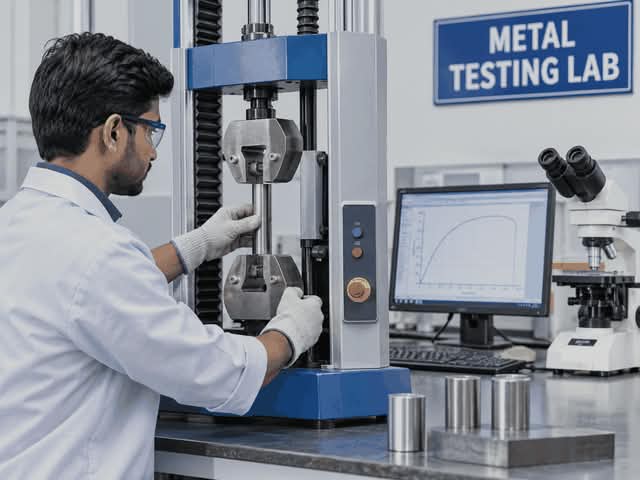
Machined metal coupons are mounted in calibrated Universal Testing Machines (UTM) to determine yield stress, ultimate tensile strength, and percentage elongation. Complementary hardness measurements and chemical composition checks verify alloy conformity, heat-treatment consistency, and weld joint soundness across industrial batches.
Key Advantages of Certified Metal Quality Testing
- Failure risk elimination: Identifies brittle alloys, low yield strength, or off-spec chemical compositions prior to fabrication.
- Audit and specification compliance: Generates traceable test certificates satisfying IS, ASTM, and client quality assurance standards.
- Incoming batch verification: Validates raw material deliveries from rolling mills, foundries, and stockists.
- Welding procedure qualification: Confirms structural integrity and ductility across welded plates, pipes, and assemblies.
Why Partner with TMTL for Metal Testing
- Computerized testing facility: Equipped with modern digital and computerized laboratory instrumentation for accurate measurements.
- Experienced technical leadership: Managed by qualified directors and specialists with extensive laboratory testing backgrounds.
- Strict quality discipline: Delivers reliable, repeatable test results designed to support demanding construction and industrial schedules.
- Comprehensive material coverage: Evaluates diverse structural metals, plates, sections, and fabricated components under one roof.
Securing Material Reliability Through Certified Testing
Verified mechanical and chemical properties protect engineering assemblies against premature wear and structural failure. Partner with TMTL for dependable laboratory metal testing and prompt certification. Connect with our laboratory team to submit samples or request a testing schedule.
Frequently Asked Questions
Which mechanical properties are evaluated in a metal testing lab?
Standard evaluations include yield strength, ultimate tensile strength, percentage elongation, bend ductility, impact resistance, and hardness.
Why is chemical composition analysis necessary for structural metals?
Chemical verification confirms exact alloy grade and controls carbon, sulfur, and phosphorus limits that govern weldability and corrosion resistance.
Which Indian standard governs tensile testing of metals?
Ambient-temperature tensile testing of metallic materials is commonly performed according to IS 1608 (Part 1).
Which industries utilize metal testing laboratories in Chennai?
Structural steel fabricators, heavy engineering plants, infrastructure contractors, automotive component makers, and marine suppliers rely on certified testing.