Dynamic Cone Penetration Test in Chennai | Expert Soil Testing
Why Dynamic Cone Penetration Testing Matters for Chennai Groundwork?
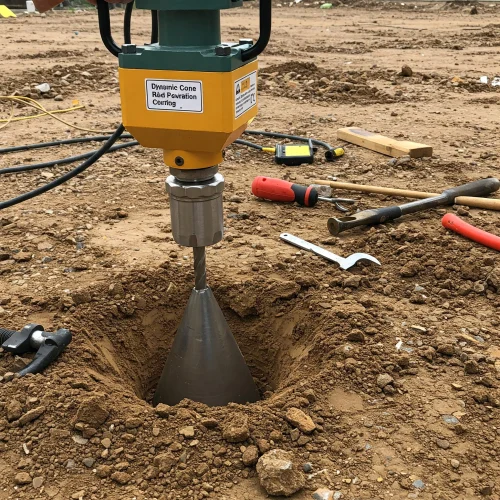
A Dynamic Cone Penetration Test in Chennai helps civil engineers evaluate subsurface soil resistance quickly without setting up a full borehole rig. Following IS 4968 norms, a conical tip attached to driving rods is driven into the soil by a falling hammer while technicians count blows per depth interval. Across Chennai, ground strata shift from sandy coastal stretches and compressible clays to firmer weathered layers inland. Early on-site sounding lets builders detect soft pockets, judge subgrade uniformity, and plan safer footings or pavements before major earthwork starts.
How Are Dynamic Cone Penetration Testing Services in Chennai Executed?
Structured Dynamic Cone Penetration Testing Services in Chennai support contractors, industrial developers, and road builders across commercial sites, factories, and transport corridors. Field teams position the cone and driving rods, drop the hammer from a set height, and record blow counts across each measured increment. Those depth-by-depth readings produce clear penetration profiles that help structural and geotechnical teams review soil stiffness and site readiness.
What Advantages Does Cone Sounding Offer on Site?
- Tracks continuous blow counts across depth to spot thin weak seams.
- Works in tight plots or open corridors where drilling rigs struggle.
- Supports subgrade and pavement checks through established penetration correlations.
- Verifies ground compaction before slabs, roads, or foundations go in.
- Helps engineers decide where deeper soil sampling or borehole testing is warranted.
- Improves site planning across residential plots, commercial layouts, and road works.
Turning Blow Counts Into Practical Site Decisions
Continuous blow-count records show where soil resistance shifts from layer to layer. When readings drop sharply, a Dynamic Cone Penetration Test in Chennai helps engineers examine localized soft zones closely before committing to foundation layouts or pavement layers.
Why Partner With Us for Subsurface Penetration Testing?
- Hands-on experience working across Chennai coastal zones, industrial hubs, and urban plots.
- Disciplined hammer drops and consistent blow-count logging at every depth mark.
- Clear, well-organized test logs ready for quick review by project consultants.
- Punctual site visits and steady coordination that fit active construction schedules.
Final Takeaway for Your Project
Sound ground verification gives Chennai construction teams reliable insight before heavy structural loads are applied. Integrating dynamic cone penetration testing early in site preparation helps catch weak strata in time, supports sound engineering judgment, and keeps project milestones moving smoothly across active builds.
Frequently Asked Questions
What does a Dynamic Cone Penetration Test evaluate?
It evaluates in-situ soil resistance by recording how many hammer blows are required to drive a cone through each set depth increment.
Which standard guides Dynamic Cone Penetration Testing in India?
IS 4968 guides dynamic cone penetration testing in India, covering procedures with and without bentonite slurry based on site conditions.
How does DCPT differ from a Standard Penetration Test?
DCPT drives a closed cone continuously without drilling a borehole, whereas SPT is conducted inside a drilled borehole at intervals.
When should a project team use cone penetration testing?
It is most useful for rapid subgrade checks, compaction screening, and identifying weak layers across accessible or space-limited sites.